How agentic AI is moving beyond prediction and rewiring healthcare and pharmacy
Apr 27, 2026 8 min read Written by Taylor Karg
Book an AI Vision Workshop, and let's build a system that works exactly how you need it to.
Book an AI Vision Workshop, and let's build a system that works exactly how you need it to.


For years, healthcare organizations have invested heavily in artificial intelligence to predict outcomes and flag anomalies. But prediction is no longer enough. The industry is reaching an inflection point where systems must move from passive observation to autonomous action. This is the era of agentic AI.
Unlike traditional models that wait for human prompts, agentic AI systems perceive their environment, make decisions, and execute complex workflows independently. The defense sector is already pioneering this shift. Recently, the Defense Advanced Research Projects Agency (DARPA) launched the MATHBAC initiative to develop the mathematical foundations for agentic communication. DARPA is essentially building the science of how multiple AI agents collaborate, share information, and solve complex problems together. This same level of autonomous, agent-to-agent coordination is exactly what the healthcare sector needs to solve its massive operational bottlenecks.
Most clinical and administrative systems today operate as static filing cabinets. There are models that can identify a disrupted supply chain or flag a patient access issue, but humans are still required to manually execute the fix. Agentic AI bridges this execution gap.
Imagine an ecosystem where intelligent agents do not just alert a pharmacist about an inventory shortage but autonomously communicate with suppliers, reroute fulfillments, and update pricing engines in real time. To achieve this level of automation, health systems and digital pharmacies cannot rely on outdated monolithic software. They require a composable, headless architecture designed for seamless API integration and data fluidity.
You cannot deploy agentic AI on top of a fragmented, legacy tech stack. To enable autonomous workflows, the underlying infrastructure must be scalable and deeply integrated.
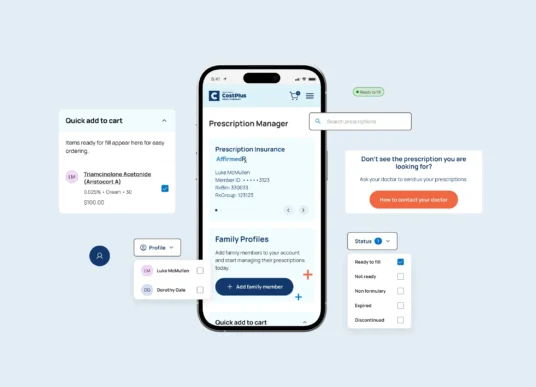
When Codal partnered with Mark Cuban Cost Plus Drugs, the goal was to optimize pharmacy operations and overcome legacy constraints. We replaced costly, rigid systems with a custom built, headless commerce architecture. By building out robust API functionality, we eliminated dependencies on third party tools and enabled real-time updates for pricing and content management.
Our engineering team implemented automated refill functionalities and complex logic sets to handle RX audits and copay issues. We also designed a custom authentication system that yielded approximately $300,000 in annual savings. This foundational transformation gave Cost Plus Drugs comprehensive data visibility and control over their ordering and fulfillment processes. It is exactly this type of modernized, API first infrastructure that serves as the strict prerequisite for deploying advanced agentic AI.
As agentic communication protocols mature, the boundary between software and human operations will blur. Agents will learn to navigate insurance claims, negotiate pricing, and optimize supply chains with near perfect accuracy. But deploying these systems requires strict governance, robust security, and deep technical expertise.
At Codal, we do not just talk about the future of AI. We build the cloud foundations and custom applications that make it possible. We combine HIPAA-compliant engineering with rapid prototyping to move your initiatives safely from pilot to production.
Stop letting legacy technology dictate your operational limits. Book an AI Vision Workshop with our team today, and let us build a system that works exactly how you need it to.
Read the full Cost Plus Drugs Case Study to see the technical blueprint behind their headless architecture.

Senior Content Writer
Taylor is a Senior Content Writer at Codal, leveraging nearly a decade of experience crafting compelling narratives for B2B publications and leading technology firms.

Explore our latest expertise on innovation, design, and technology, or connect with us directly to see how we can help accelerate your digital transformation.