Is your website ready for AI agents? The framework behind a real AI agent-readiness audit
Jul 3, 2026 15 min read Written by Jason Jackson


For twenty years, the question was: can a person find and use your website? That question is quietly being replaced by a new one: what’s your AI agent readiness?
Shopping assistants compare products across stores. Research agents summarise services. Buying agents complete purchases on a user’s behalf. When someone asks an AI assistant to “find the best-reviewed option under $200 and add it to a cart,” an AI is reading your site, navigating your menus, and trying to act, with no human eyes, no mouse hover, and no patience for a page that takes JavaScript a second to fill in.
The uncomfortable part: a site can look perfect to a human and be nearly invisible, or unusable, to an agent. They’re two different audiences now, and most sites have only ever been built for one.
So we built an audit to measure the gap. This post explains the framework behind it: what we evaluate, how we score it, and why.
AI search is the most hype-saturated topic in marketing right now. Every week brings a new “you must do X to rank in AI.” Most of it is untested.
So the framework is built on a deliberate principle: weigh what the evidence supports, and be honest about what it doesn’t. Three findings shape the whole thing:
That last point is the single most actionable thing in the field, and almost nobody optimizes for it. It’s why our framework weights content far above protocols.
A note on intellectual honesty: these are findings from a fast-moving area, current as of early 2026. We treat them as well-supported heuristics, not eternal law, and the report says so.
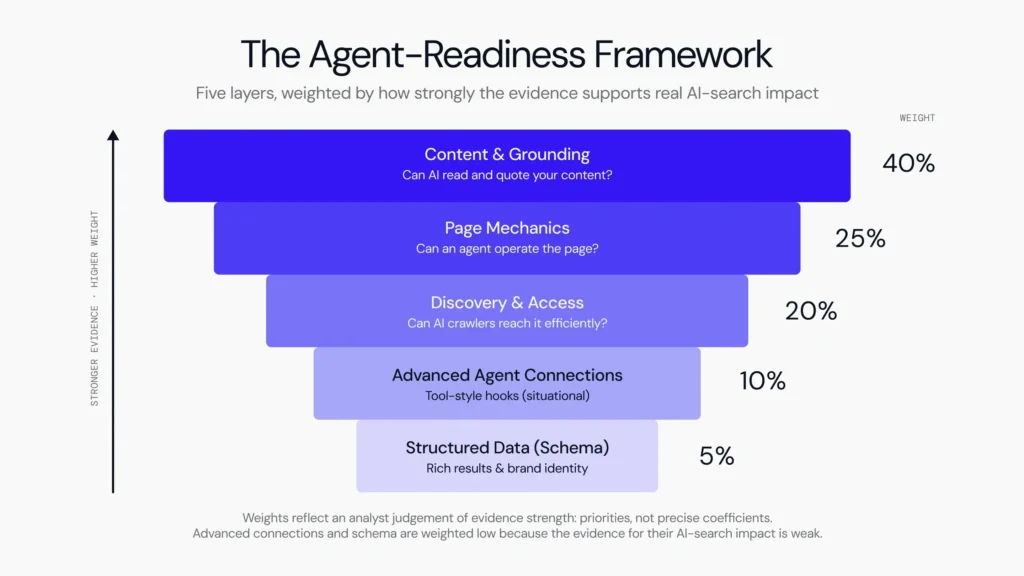
We evaluate a site across five layers. Crucially, the layers aren’t weighted equally. They’re weighted by how strong the evidence is that the layer affects real outcomes. A site can’t earn a good score by stacking up easy-but-low-impact wins.
| Layer | What it measures | Why it’s weighted this way |
| Content & grounding | Is there enough focused content, with the answer near the top, in a form AI can read? | Highest weight. Strongest evidence for real AI-search outcomes. |
| Page mechanics | Can an agent read the page’s structure, controls and accessibility cleanly? | High. Directly governs whether an agent can operate the page. |
| Discovery & access | The files that tell AI crawlers what they may read and how to read it efficiently. | Medium. Real, but legibility, not a ranking lever. |
| Advanced agent connections | Emerging standards that let AI assistants connect to your site as a tool. | Low / situational. Most sites don’t need these yet; we say so. |
| Structured data (schema) | The markup behind Google rich results and brand recognition. | Lowest for AI. Valuable for rich results, but not strictly an AI-citation lever. |
One detail that matters for fairness: the weights are an analyst judgement of evidence strength, not a falsely precise formula. We’re explicit in the report that they’re priorities, not measured coefficients, because dressing a judgement call up as a precise number is exactly the kind of false precision the framework exists to call out.
We also tailor the scoring to site type. The “advanced agent connections” are genuinely expected of an API or SaaS product, but not of a typical store or content site. So for a store, their absence isn’t counted as a failure; it’s marked not applicable. The audit doesn’t penalize a business for not being something it was never going to be.
A few decisions under the hood that make the score trustworthy:
Most “AI readiness” tools only inspect files. Ours does that too, but it also runs a live agent through real user journeys and reports, in plain language, what worked, what failed, and where the agent got blocked.
For an eCommerce site, that means testing whether an agent can:
We group these into four task dimensions: product discovery, navigation, task completion, and form handling. That way, the report doesn’t just say whether a site is “agent-ready” or not. It shows exactly where in the journey an agent succeeds and where it gets stuck.
This is where the human-vs-agent gap shows up most starkly. A recurring pattern: a site’s headline metrics look healthy, but the moment an agent tries to act (open a menu, add an item, reach checkout), it hits a wall a person would never notice. The classic example is hover-dependent navigation: menus that only open when a mouse moves over them. Flawless for a human; a complete dead end for an AI agent (and for keyboard and touch users). A files-only audit will never catch it. Driving the site does, instantly.
The highest-weighted layer deserves a closer look, because it’s the one most sites get wrong without knowing.
Many AI crawlers and chatbots read the raw HTML, the page before JavaScript runs. If your product details, prices, or descriptions are injected by JavaScript after load, an AI may see an empty shell where a human sees a full page. We detect this directly: when the visible text is tiny but the page is heavy with scripts, that’s the signature of content an AI can’t see.
Then, for the content that is readable, we evaluate whether it’s structured to be used: is the answer near the top (where AI quotes from first)? Is the page focused, or so long that the useful part gets diluted? Does it have a clear heading and a marked-up main content region so machines can tell the content from the chrome?
These aren’t abstract niceties. They’re the difference between being the source an AI quotes and being the page it skips.
A score is useless if nobody can act on it. So every finding, across all five layers and the live agent run, is written for a human, not a spec sheet:
There’s no internal jargon, no acronyms, no spec numbers. A schema finding doesn’t say a type “lacks sameAs.” It says: “Your brand markup is missing links to your official profiles; adding them is how Google confirms you’re a known business and the basis for a Knowledge Panel.” The engineering team gets a node-by-node fix list with exact elements; the marketing lead gets a prioritized summary they can actually read.
Two more things that matter if you’re going to act on a report:
Act now: eCommerce brands, anyone tracking AI-search visibility, businesses whose customers are already using AI assistants to research and buy
Plan for it: publishers, lead-gen sites, local businesses with high-intent buyers
The brands that get agent-ready while their competitors are still invisible to AI will own a channel that’s wide open today. That window won’t stay open.
Your website was built for human eyes. AI agents are a new kind of visitor, one most sites are turning away without realizing it.
Codal’s Agent-Readiness Audit measures the gap across five evidence-weighted layers, drives your site like an agent to prove what actually works, and hands you a prioritized, plain-English plan to close it.
Want to know how agent-ready your site is? Get in touch for an audit.

Lead Technical SEO Strategist
Jason is a Lead Technical SEO Strategist at Codal, managing enterprise SEO strategy and implementation. He has over a decade of experience helping brands across industries, such as eCommerce, healthcare, and finance, achieve their digital growth goals.

Explore our latest expertise on innovation, design, and technology, or connect with us directly to see how we can help accelerate your digital transformation.