Fireside chat with Cost Plus Drugs: Building technology for mission-driven businesses
Jun 2, 2026 11 min read
Mark Cuban Cost Plus Drugs Company (CPD) has become one of the most disruptive forces in American healthcare, and not through complexity but through radical simplicity. A transparent pricing model, a commitment to patient access, and a willingness to challenge entrenched industry actors have made CPD a genuine category disruptor.
In this Codal fireside chat, Codal’s Director of Product Innovation Rahul Yadav and Senior Product Manager Farsh Umrigar sit down with CPD’s CFO Jon Horbaly to unpack the architecture behind the Cost Plus model. They also discuss how the company is scaling across multiple business lines, what it looks like to build meaningful technology partnerships in a mission-driven company, and more.
At its core, CPD is exactly what the name implies: acquisition cost of the drug, plus 15%. No hidden fees, no PBM markups, no opaque pricing tiers. The business was born from a simple but powerful observation: drug pricing in America is artificially obscured by a chain of intermediaries, and that obscurity costs lives.
“Mark always says he doesn’t want anybody to ever have to decide between a life-saving medication and putting food on their table. That’s why everybody in our company is here.”
Jon Horbaly
The model began with a humbling financial reality: a 15% markup on a small volume of generic drugs barely covers operations. The early days required both patient capital and vocal advocacy. In Mark Cuban, CPD found both. As Jon describes it, Mark’s willingness to be a public champion for the mission gave the team the space to build.
What started as a direct-to-consumer pharmacy has expanded into a full-stack pharmaceutical ecosystem. CPD’s leadership made a strategic decision early: planting a single stake in the ground wouldn’t be enough. The problems of drug pricing would simply route around them.
1: Direct-to-Consumer Pharmacy
2: B2B Marketplace for Healthcare Providers
3: Manufacturing & Compounding (503B)
4: Affiliate Pharmacy Network
5: Employer & PBM Solutions
“If we just put one stake in the ground, the problems of the industry would just move right around us. We had to lay several stakes with synergy to be a full solution for the entire supply chain.”
Jon Horbaly
Our engagement with Cost Plus Drugs isn’t transactional. It’s structural. Working across 20 to 25 concurrent projects, the teams meet biweekly to assess priorities, security posture, and ROI, defined not just in dollars but in patient outcomes and ease of access.
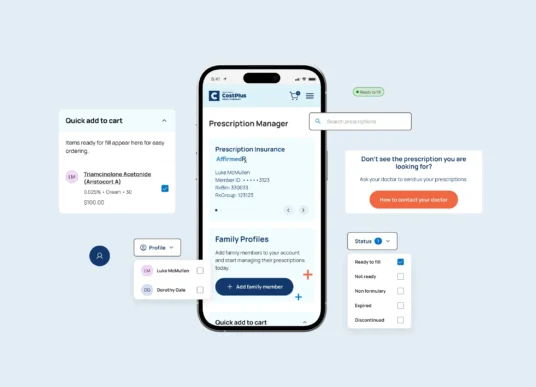
Beyond the consumer experience, the partnership has expanded into broader operational transformation efforts. Codal has supported platform modernization initiatives, scalability improvements, fulfillment optimization, B2B marketplace enhancements, and emerging innovation efforts like Pharma Co-Pilot manufacturing pods.
The relationship has evolved from feature delivery into long-term systems thinking: identifying operational bottlenecks, simplifying architecture, improving maintainability, and helping CPD scale responsibly while maintaining affordability.
When we re-evaluated the costplusdrugs.com tech stack, the goal wasn’t to add complexity. It was to remove it. The result was a leaner, more flexible architecture that lowered operating costs and created room for new features like auto-refill.
We’re also collaborating with CPD on pharma pods, which are mobile sterile injectable manufacturing trailers that could bring drug production closer to the patients who need it most. These mobile manufacturing environments represent a broader shift in how pharmaceutical supply chains may evolve in the future. Rather than relying solely on centralized manufacturing and fragile distribution networks, CPD is exploring localized production capabilities designed to improve resiliency, reduce shortages, and bring manufacturing closer to patients and providers.
For Codal, this introduces a completely new category of digital enablement challenges and which spans compliance workflows, real-time monitoring, AI-assisted operations, traceability, and systems integration.
Jon’s framing captures the dynamic well: “CPD operates on a roughly 13% net margin to run an entire business. Every technology decision is a cost decision. A partner who understands that, and who proactively identifies inefficiencies rather than just scoping new work, is not a vendor. They’re a teammate.”
Jon’s take on AI is worth pausing on, because it reflects a maturity that many healthcare organizations are still developing. “I think it’s overhyped,” he told us. “I also think it’s underhyped.”
The overhype comes from investor and board pressure forcing AI into contexts where it does not belong. The result is negative ROI and organizational fatigue. CPD has taken the opposite approach: deploying AI specifically against inventory organization, repetitive operational tasks, and decision-support, always assessed against a clear question of whether it saves time, money, or headaches.
“Being well-defined in what you’re going to develop or what you’re going to use it for matters,” Jon said. “Building AI on top of something is harder than building it from scratch.”
In healthcare particularly, this is the difference between AI that survives board scrutiny and AI that does not.
One of the most overlooked realities of healthcare innovation is that disruptive business models often operate on razor-thin margins. Cost Plus Drugs intentionally limits its markup structure to maintain affordability, which means every operational and technology decision must justify itself financially.
As Jon explained during the conversation, technology investments are not evaluated based on novelty, but on whether they directly reduce operational overhead, improve customer access, or eliminate inefficiencies.
“We have to cover overhead, development, and personnel while still reinvesting in growth. A partner who understands that doesn’t recommend things just to do another deal.”
This philosophy has shaped how Codal approaches the partnership: focusing on simplification, operational efficiency, scalable architecture, and measurable ROI rather than unnecessary platform complexity.
When asked what it will take for CPD to become the dominant name in pharmaceuticals, Jon’s answer is purposefully basic: keep it simple, keep innovating, and never lose sight of who you’re serving. In an industry defined by complexity and opacity, simplicity is the differentiator.
“We sell trust,” Jon says, echoing Mark Cuban. The business could extract more margin, the playbook exists, but doing so would erode the one thing that makes CPD’s model work at scale: the belief that they are unconditionally on the patient’s side.
The partnership between Codal and Cost Plus Drugs reflects what modern healthcare transformation increasingly requires: mission-driven leadership paired with practical technology execution.
For CPD, innovation is not about adding complexity. It is about removing friction, eliminating obscurity, and making affordable healthcare more accessible at scale.
For Codal, that means building systems that are operationally efficient, compliant, scalable, and adaptable enough to support entirely new models of pharmaceutical access.
If your organization is managing complex workflows, fragmented systems, or trying to make a case for technology investment that has to justify itself on tight margins, that is exactly the environment where Codal operates well.
We work with healthcare, life sciences, and compliance-heavy businesses that need a partner invested in the outcome, not just the engagement.
Get in touch with our team: contact us
Read the full Cost Plus Drugs case study: Mark Cuban Cost Plus Drugs

Explore our latest expertise on innovation, design, and technology, or connect with us directly to see how we can help accelerate your digital transformation.