Streamlining data exchanges between insurers and law firms to drive efficiency & improve claim outcomes
Codal partnered with ClaimDeck to design and build a litigation management platform from the ground up, streamlining workflows, centralizing data, and enabling powerful AI-driven insights. The result is a modern solution that improves collaboration between insurers and law firms while reducing inefficiencies in claims management. ClaimDeck’s commitment to digital innovation has even earned it the title of “Overall Case Management Company of the Year” at the LegalTech Breakthrough Awards.
GROWTH IN USERS SINCE 2021
800%
INCREASE IN ONBOARDED CARRIERS & TPAs
70%
DATA POINTS PER CLAIM
1,400+
A cutting-edge litigation management platform, ClaimDeck streamlines the processing of insurance claims by automating legal workflows, visualizing insightful data, and improving communication between insurers and lawyers.
The challenge
There are many legal communications, documents, and tasks involved in the processing of insurance claims, which are traditionally handled by isolated parties and technologies. When an insurance company recruits a law firm to help resolve one of their claims, the claim adjuster works with the lawyer to achieve the best possible outcome. However, this work is often hampered by disparate communication channels, redundant workflows, incomplete data, and accidental noncompliance with ever-changing industry standards.
As a result, insurers experience two key issues:
Claims leakage: This refers to the amount of unnecessary expenditures due to a claim’s process errors and inefficiencies.
Unstructured data: When data is siloed across multiple sources, stored in its native format, and doesn’t follow a conventional data model, it becomes increasingly difficult for a growing organization to manage, activate, and share that data.
Insurtech companies have tried addressing these issues in the past, delivering clunky software products to a user base of legal professionals who are anything but tech savvy. ClaimDeck envisioned a new kind of litigation management platform — one that’s as visually appealing and user-friendly as an Apple product — to help users resolve claims more effectively.
ClaimDeck teamed up with Codal to turn this vision into a reality and go to market fast. Our challenge was to strategise, design, develop, test, and launch this game-changing litigation management platform in just a few months.
The solution
Codal spent weeks learning the ins and outs of claim litigation, conducting research and interviewing stakeholders to nail down project requirements, from the new platform’s overall look and feel to necessary features and functionality.
We identified two key user types:
Claim adjusters: Individuals hired by the plaintiff’s insurance company to investigate and handle the claim.
Lawyers: Individuals hired by the insurance company to represent the plaintiff and work through the legal proceedings, under the claim adjuster’s oversight.
The design of the platform needed to convey trust, transparency, security, and accountability. After all, ClaimDeck users would be managing legal documents with sensitive information on the platform. It also needed to stick out among other claim litigation platforms, which typically display data in standard, uninspiring tables, making it difficult for users to tell the story they really want to tell.
By the end of discovery, we had outlined a roadmap to success with key deliverables and milestones, and were ready to start building a litigation management platform that:
Makes it easy to assign tasks and check the status of insurance claims.
Centralizes data from multiple sources into a single location.
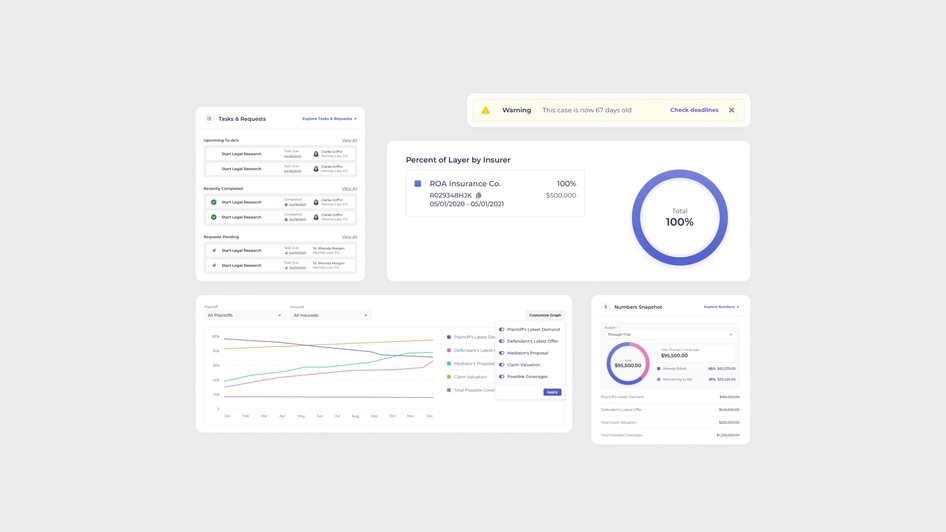
Visualizes that data with customizable charts and graphs for actionable insights.
Streamlines the auditing process by providing a full and detailed history of activities.
Allows claim adjusters and lawyers to chat directly on the platform.
Stores clean, well-structured data to support AI and ML capabilities down the line.
Comprehensive claim management & task automation
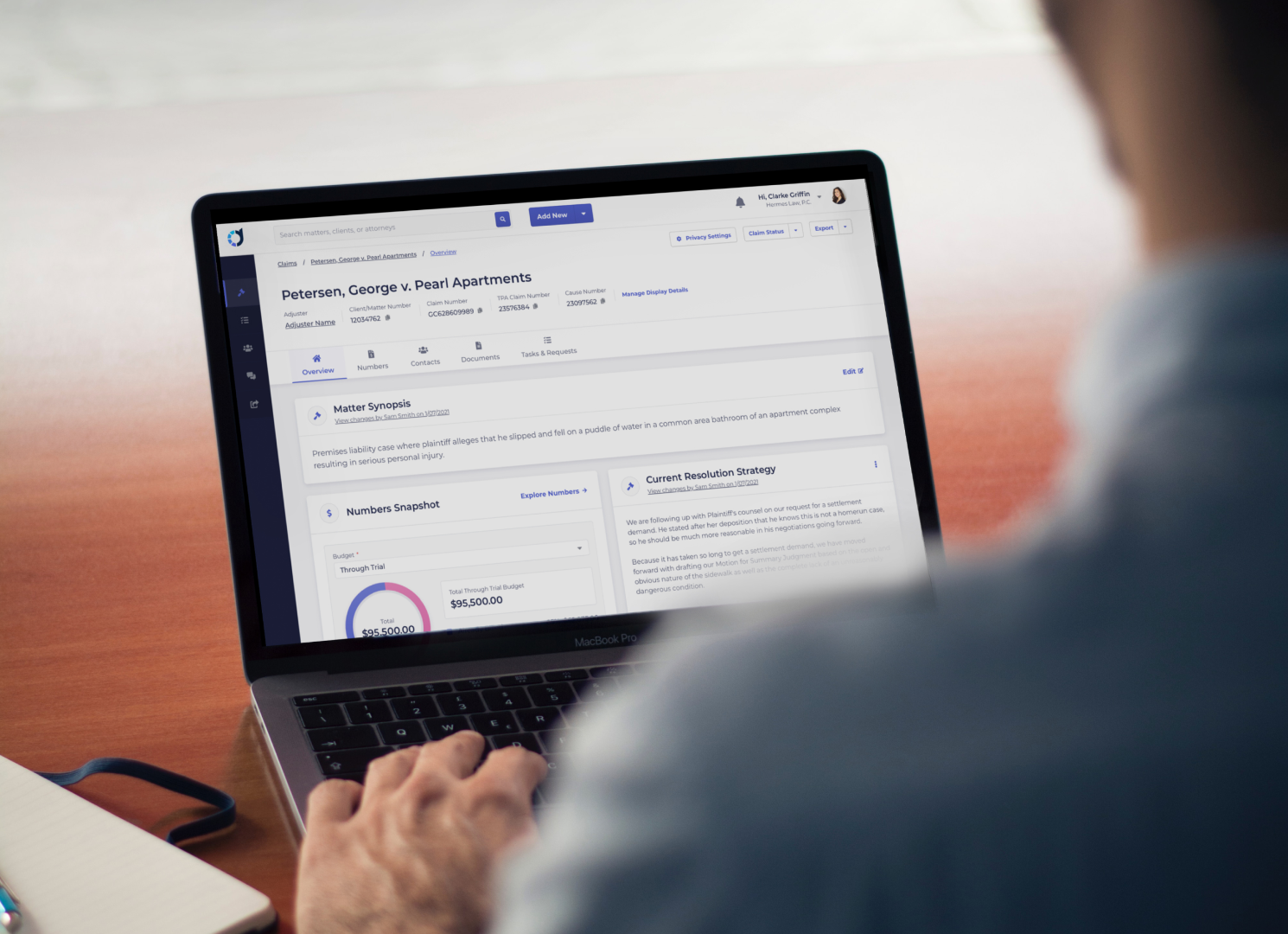
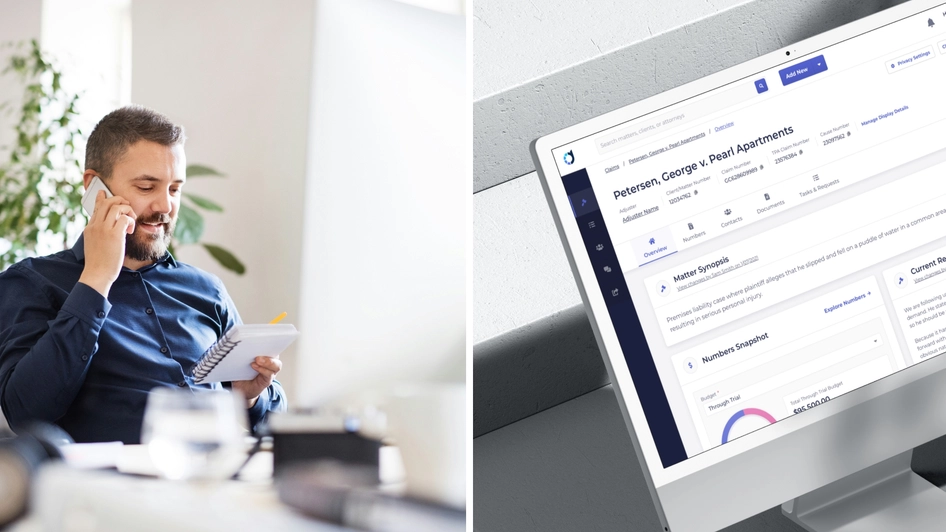
Codal built a Claim Overview page, where users can find all details relevant to any specific claim, including synopsis, tasks, requests, budgets, settlement negotiations, legal documents, and more.
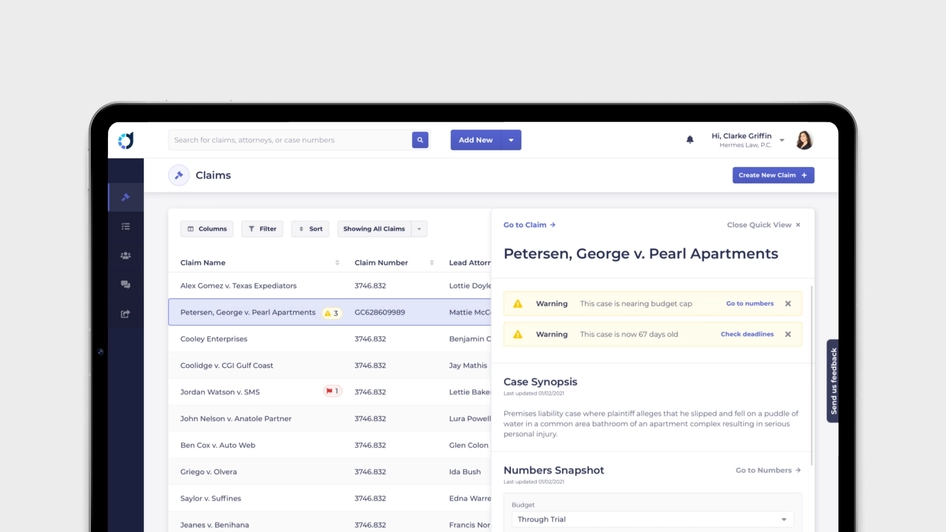
When looking at their list of hundreds of claims, users can search for claims, see which ones have overdue tasks and other alerts, as well as display a snapshot (a high-level overview) of the claim, without having to open a new page and navigate through a plethora of content. These features allow claim adjusters to get up to speed on the status of their claims as efficiently as possible.
To help move claims from one stage to the next, our team built functionality that enables users to create tasks for other users attached to their claim. Lawyers assign tasks to claim adjusters to complete activities that require budget approval, such as authorizing a proposal for a settlement negotiation, confirming whether something is covered by the plaintiff’s insurance policy, hiring an expert witness, and other legal actions. When these tasks show up in their queue, the claim adjuster can either approve or deny the request.
To better reflect how carriers and TPAs actually delegate, follow up, and track progress, we enhanced the Tasks & Requests workflows to make handoffs between adjusters, attorneys, and clients faster and more transparent. We also implemented a Matter Score configuration by line of business (LOB) to enable carriers to set custom compliance scoring that gives users the precision needed to spot risk before it escalates.
With a long list of tasks and requests at any given time, users can quickly find the ones they’re looking for through the platform’s advanced search and filtering capabilities. And when tasks are overdue, the user receives automated alerts.
A Zendesk AI chatbot support system delivers in-platform answers in seconds so users don’t have to dig through countless pages of PDFs or wait for a call back. Finding answers is as simple as a click away. We also updated the Document center with increased storage and enhanced search and audit functionality to help reduce friction and increase visibility.
For greater transparency and compliance, we designed an Activity History page that shows all tasks, requests, and modifications within a claim. Users can see when a task was assigned and completed, and when the name, number, or synopsis of a claim was changed, along with all previous versions of the claim data. With so many moving parts associated with a single claim, scrolling through a long list of activities would be tedious, so we implemented advanced search and filtering capabilities that narrow down the data. For example, if a user wants to know a claim’s previous claim numbers, they can simply select “Claim Number” as a data type, then see all activities related to the claim number. In addition to helping legal teams stay organized, this functionality provides quick and easy access to data that’s required in the auditing process.
Within each claim, users can navigate to the Claim Valuations section, which automatically calculates the total dollar amount of damages multiplied by the probability of verdict, or, the percentage of how likely the jury will return a verdict in favor of the plaintiff. We implemented complex back-end logic to make this feature available, saving significant time and effort for users on the front end.
To help manage each claim’s budget, we designed a page that automatically calculates the cost of certain activities, based on the amount of working hours needed from partners, assistant attorneys, and legal assistants. The cost of these activities is added up and presented as a total budget, requiring no manual calculations from the user.
Users can also navigate to the Settlement Negotiations page, which visually communicates how close or far always the plaintiff and defendant are from settling the claim. There’s a graph that shows three lines: One representing the plaintiff’s compensation demands for settlement, one representing the defendant’s offer, and the other representing the mediator’s proposal. By visualizing this data in a color-coded line graph, users can get up to speed rapidly on the settlement negotiations for any given claim.
Legal data architecture & NLQ-driven AI innovation
To make the insurance carriers and law firms using ClaimDeck more analytics driven, we developed a system for extracting and structuring massive amounts of data, which can be used to measure performance and improve workflows. The platform captures over 1400 data fields per claim, which translates into thousands of data points. Rather than presenting this data in a large, black-and-white table, our team designed an intuitive, configurable dashboard that allows users to engage with data in easily digestible charts and graphs.
As the system continues to capture data, it can be further leveraged to enable AI and ML capabilities for more accurate predictions around claim outcomes. Here, our team has built a system that houses critical, historically disparate data under one roof, which helps optimize performance, and lays the foundation for more advanced, AI-powered features and functionality.
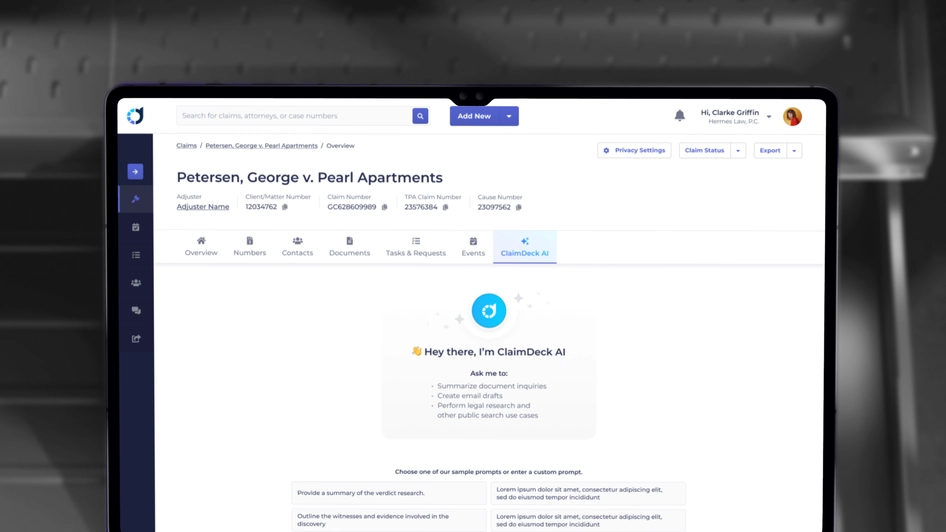
In a major milestone for Codal, we successfully launched ClaimDeck’s NQL-driven (natural language query) AI chatbot. Using advanced AWS technologies, including Bedrock, Kendra, Lamba, DynamoDB, and API Gateway, the solution automates tedious document analysis. This chatbot is able to:
Summarize pre-existing PDF legal documents
Generate templates and drafts for new legal documents
Draft email communications between parties
Conduct legal research using publicly available data
We also created an engaging UX/UI for the chatbot to provide an easy-to-use and intuitive experience for users, akin to the familiar chatbot aesthetic.
ClaimDeck’s data-exchange capabilities were significantly upgraded to now support client-built integrations, like internal BI tools, dashboards, and case management systems, to empower more accessibility for users. The Snapsheet integration was also upgraded to improve data sync and claims lifecycle tracking. This helps ClaimDeck align more tightly with users’ existing ecosystem, minimizing double entry and speeding up time to resolution.
And finally, we implemented a messenger feature to improve communication between claim adjusters and lawyers. By enabling both parties to chat directly on the platform, this user-friendly tool eliminates the need for back-and-forth emails and phone calls. Also, similar to the Activity History feature discussed above, all communications from the messenger tool are captured for the sake of auditing.
The result
Codal operated multiple work streams in parallel to meet ClaimDeck’s desired launch date. We built a best-in-breed litigation management platform that is:
Easy for insurance companies and law firms to implement in hours, rather than months.
Seamlessly integrable with other technologies, due to its open API infrastructure.
Able to ensure data integrity by automatically capturing and maintaining over 1400 data points per claim.
Continuously improving, with new features and updates released every two weeks.
Cloud native, hosted on AWS.
Secure, maintaining SOC 2 compliance as part of ongoing security operations.
The platform’s impact is supported by ClaimDeck’s 2025 performance stats, which include:
800%+ growth in organizations using ClaimDeck since 2021
70% increase in Carriers and TPAs onboarded compared to the previous year
97% customer satisfaction on Zendesk support and a 3x increase in law firm participation
Over 4,000 users now managed litigated claims with a 93% positive training feed
The ClaimDeck platform centralizes and automates claim management with a slick UX/UI that legal professionals trust. By reducing case life by 200+ days and bringing legal costs under control through real-time metrics, ClaimDeck is helping insurers and lawyers around the world become more efficient and analytics driven.
As ClaimDeck’s digital innovation consultancy partner, we’re excited about their continued success. We look forward to building on this now and far into the future, working together to create the best claims management platform experience we can.
If this case study sparked ideas, let’s talk. From strategy and experience design to unified commerce and product engineering, Codal helps ambitious brands turn vision into reality.