Codal partnered with ACCME to design and develop the Learner Reporting System (LRS), a centralised platform that streamlines accreditation management for administrators, medical board members, and course providers. By modernizing UX/UI, improving data visualization, and building a robust Angular and Django-based system, the platform now enables faster, more intuitive access to millions of records.
ORGANIZATIONS MANAGED ON 1 PLATFORM
1,700+
CREDITS TRACKED & REPORTED
1.5M+
COMPLETION RECORDS ACCESSIBLE
400,000
The Accreditation Council for Continuing Medical Education (ACCME) identifies, develops, and promotes rigorous national standards for quality medical education to improve physician performance and patient care.
The challenge
ACCME needed a central hub where medical certification boards could manage, track, and report various accreditations. The LRS would be an inherently complex platform with a wide range of user types, so our UX/UI design team needed to ensure that the user experience was personalised, yet consistent, for all use cases.
The solution
Codal began by examining the LRS’ predecessor, a platform called PARS. Noting the pain points in its UX/UI, our designers determined what areas needed an overhaul and which ones needed a simple refresh.
Through heavy collaboration between ACCME stakeholders, our design team, and business analysts, a feature list for the first release was solidified. We crafted a new sitemap that reorganised the content of the site while accommodating new features and functionalities.
Our team mapped out a three-phase plan to meet ACCME’s project requirements:
Design several different platform interfaces to meet the specific needs and expectations of each user type.
Tailor the platform’s layout to complement large amounts of data visualization.
Engineer the platform’s front and back end utilising the frameworks Angular and Django.
Modernising UX/UI and data management for a seamless accreditation experience
Due to the size and activity of the platform’s current user base, our UX/UI designers modernised the look and feel of the preexisting site—so as not to alienate current users and potentially disrupt workflows. After formulating a high-level design strategy, Codal began crafting barebones wireframes.
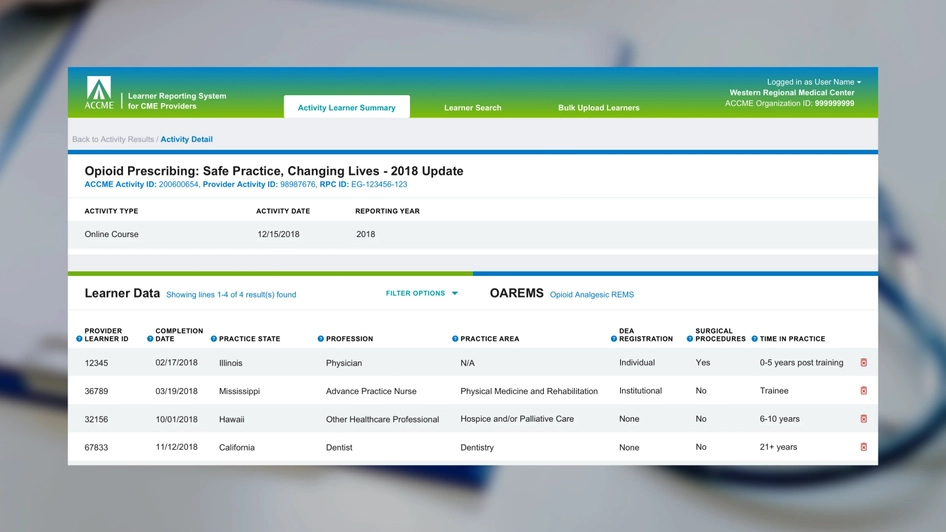
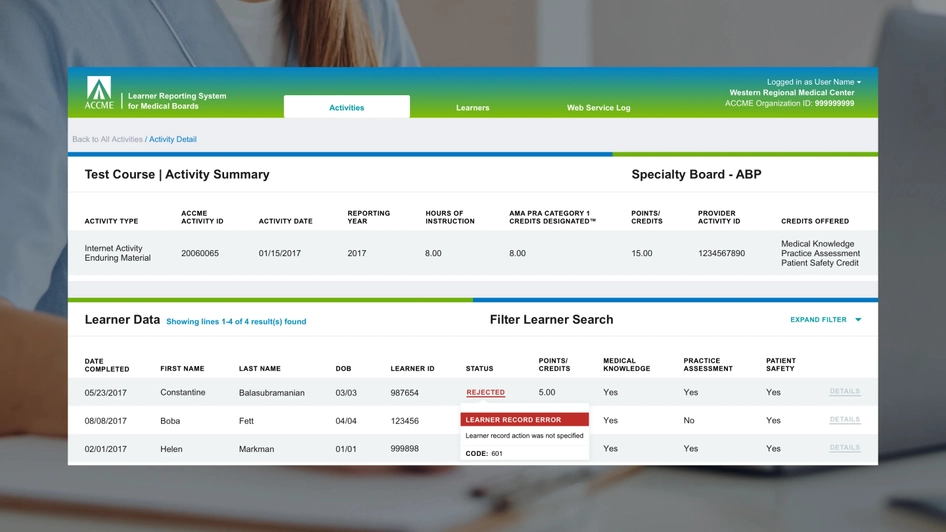
One of the challenges of the previous platform was poor data visualisation—tables had poor readability, content was difficult to find, and the search process was maddening. Our team remedied this flaw by not only introducing sorting and filtering functions, but also improved search results, restyled tables, and a feature that allows users to input data en masse.
We also needed to tailor different iterations of the website to various user personas. ACCME’s learning system needed to serve administrators, medical board members, and course providers. And the user experience needed to be personalised, yet consistent across different user groups.
By modernising the existing aesthetic of PARS, Codal was able to imbue the updated platform with a familiarity that would resonate with all user types. Yet within that general look, Codal rearranged and reprioritised functions to match specific user needs and expectations.
The best efforts of our UX design team are in vain without a robust development process for translating designs into actionable, usable code. To buttress LRS’ retooled user journey, Codal’s engineers built out both the front and back end of the web platform.
The front end was constructed in AngularJS, a framework that allows for simplified, agile development and testing. And the back end was built with Django, a Python framework that enables rapid development and reusability of code.
The result
Codal was able to design, develop, test, and launch a highly complex and cutting-edge platform in just six months.
ACCME’s LRS currently houses around 1,700 accredited organisations, 1.5 million credits, and 400,000 completion records. And thanks to Codal, administrators, medical board members, and course providers can access and report this data through a fast, intuitive, and personalised user experience.
If this case study sparked ideas, let’s talk. From strategy and experience design to unified commerce and product engineering, Codal helps ambitious brands turn vision into reality.